By the end of July, all Albanians, residents or non-residents, who have a bank account within Albania, will need to fill out a self-declaration form. Through an email, all second-tier banks have asked their customers to state their residential address and tax number. These data are collected within the framework of the law of automatic exchange of information, which entered into force in January this year in our country and is part of the global initiative to combat evasion.
Vasilika Vjero, Deputy Minister of Finance and Economy, told Monitor Ekonomi that the Law on Information Exchange provides an opportunity for the Albanian tax administration to exchange information regarding bank accounts, balances of these accounts, with capital gains by including dividends, interest, income from the sale of assets, for those individuals who are not residents of the Republic of Albania and on the other hand, to be able to obtain information from the counterpart tax administration or from other similar structures, regarding Albanian individuals who may have accounts with those states. â?
When it comes to personal data, we can often have doubts about what this information will be used for. Businesses are particularly concerned that the information that taxes can take from bank accounts may be misused.
Mrs. Vjero says: â??I think that banks should be very careful in collecting this information or sending this form only to those who will be subject to this law, but of course this is a law that guarantees the protection and preservation of personal data, of the individual because the tax administration itself has a very high weight in the storage and protection of this data and of course this law in particular guarantees these. â?
Altin Koçi, head of the compliance sector at Union Bank, claims that customers have no reason to be concerned about the misuse of their personal data. "The data that will be collected by the banks is generally there and is stored through an existing law. This law is not only being implemented in Albania, it has even entered here relatively late. It was discussed in 2014, then in 2016 and now again. There are over 100 countries that have acceded to this agreement known as CRS or automatic information exchange. So all Albanians, whether here or abroad, have either been recognized or will be recognized by this law which will act everywhere in the world. â?
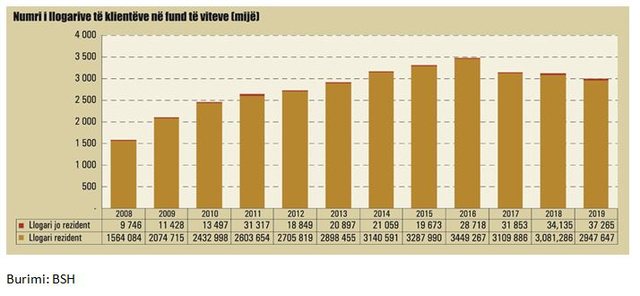
At the end of 2019, the Bank of Albania reported that the number of bank accounts had reached over 2.94 million. Holders of these accounts will fill out self-declaration forms, with personal data such as name, place of residence and tax number.
According to Mr. KOÃ?I, â??There is a legitimate hesitation, because since they opened the account many years ago, this documentation has never been requested and as in any application, the new law or the required documentation has a hesitation from the population, this and for reasons for not informing or not understanding in depth this law. The authorities need to provide more information, because this is a tax law, not a banking one, and it is not up to us to give advice even though we have tried to explain it to our customers. â?
The tax administration provides for the collection of information by the end of the year and next year the exchange with counterpart administrations outside Albania will begin.
Vjero claims that â??We will provide such information and on the other hand, we will receive information from all counterpart administrations regarding all accounts of Albanian residents in the institutions they have abroad. It will be up to the tax administration to investigate, to ask for more information about these accounts, which have not been declared, and to tax them where needed. â?
Implementing the law at the height of pandemic has made it difficult for the banking system to meet this obligation, but it has also created additional costs for them. While there are many clients who are still unclear about this legal change.
Koçi claims that â??At the moment there are problems because it comes at a difficult time where all the attention is focused on the pandemic, on the financial measures taken by the government and where the banks have a very important role. On the other hand, this procedure requires investment, not much in terms of infrastructure, but requires manpower with dedicated personnel. This is a broad law and requires procedures, standards, rigorous implementation and therefore requires dedicated staff to deal with this work. It depends on the size of the bank, but in many of them where there are some people who deal with this work without discussion that creates costs. "
Self-declaration is made at bank counters or online platforms, a service that is being offered to avoid long queues, especially with the presence of Covid, where physical distances must be respected. Individuals should consider making a declaration by July 31, as the law also provides for sanctions for exceeding the deadline.
Individuals and businesses will self-declare their place of residence and tax number with a special form. This data, along with information on bank accounts, could be used by tax authorities in 112 countries as part of a global initiative to combat tax evasion, part of which is Albania.
This self-declaration process is an obligation deriving from the Law on Automatic Information Exchange between European countries, which entered into force in Albania in January this year. The law aims to open bank accounts for tax institutions and combat the problem of tax evasion in offshore accounts and avoid raising money abroad.
From the point of view of the law, non-residents living in Albania are forced to fill in the form, but since there are many Albanian citizens who have more than one tax residence, where the largest share is held by immigrants, banks in Albania have decided to call to fill out the form all account customers.
As of May this year, total bank deposits were about 8.5 billion euros, according to the Bank of Albania, which is equivalent to 62% of gross domestic product.
Source: Monitor.al