A landmark victory has been cited by art critics and the biggest protagonists of cinematography, the four-time Oscar-winning trilogy of the movie Parasite, yesterday evening during the prestigious awards.
Four awards, including Best Director by Bong Joon Ho, Best Photography, Best Foreign Language Film and Subject, South Korean thriller has convincingly diversified the concept of filmmaking because "Parasite" made history with the fact that the subject opposes the class struggle in the face of all situations where a rich and a poor family are placed.

No film from South Korea had previously been nominated for such prestigious awards in Oscars history. The Film Academy has dramatically expanded the contingent of film feeds and subjects as a necessity to "mix" cultures! Last year, the academy invited 842 film industry professionals to become members, from 59 countries.

The overwhelming victory of "Parasit", with a predominantly Asian cast, showed the film world the importance of cultures and origins. In honor of Parazit, voters slowed Netflix's rise, a platform that entered the 92nd edition of the Academy Awards with a major field nomination, but remained with only two awards. Netflix won for Best Documentary for "American Factory," a documentary about a clash between a Chinese entrepreneur and another from Ohaio, and actress Laura Dern won the trophy as the supporting actress for "Marriage Story," a production by Netflix.
Each of Bong Joon Ho's films is extraordinary in its own way, as the director sheds light on the serious issues by bending the medium of the genre film to his liking. With "Parasit," the 50-year-old filmmaker clearly articulates a long line that has been present in all of his previous work: no war, but only class war.

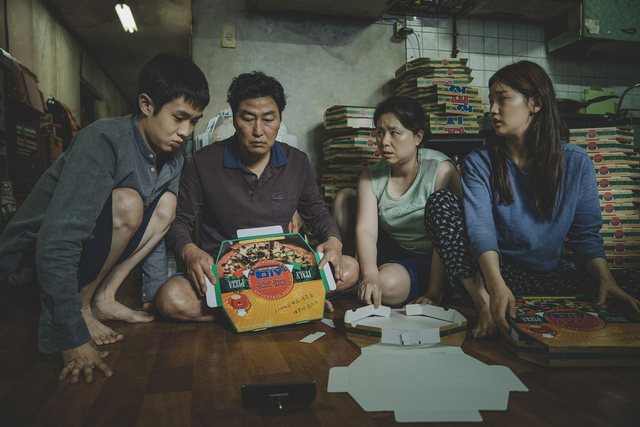
In his latest work, Bong constructs a conjugal story under a disturbing and illuminating effect. The film focuses on the working-class family of Kim, who live in the basement of an apartment that never catches the sun. Ki-Woo, the family's son, is referred by a friend to teach the daughter of the wealthy Park family.
When Ki-Woo arrives at this family home, a stunning estate designed by a famous architect and created as an extraordinary scene by a digital magician, his eyes light up with envy for everything he and his family cannot have.
Gradually, Ki-Woo replaces the Park family staff, with members of his family, most notably his father, Ki-taek, who embodies a working class. Once his family settles in the wealthy family home, Ki-taek tests the limits of how much the rich and their lives can be manipulated.

No doubt the Kims are parasitic when crossing the home of the rich Park! Dad works as a driver; sister becomes art teacher for hyperactive boy; and the cleaning mother. But Parks also are, in a way, the caterpillars, who use this poor family to fill the nutritional and emotional roles that they cannot. It's a zero-sum game ...

The problem the film argues is that we accept these things as normal. The Kims have no option but to get together to plan their next opportunity; it is the only way they can achieve society's idea of respect. The American Dream, in other words, is not exclusively American.
This movie is definitely one of those that pushes you to watch it and will surely stay in your mind for a long time!