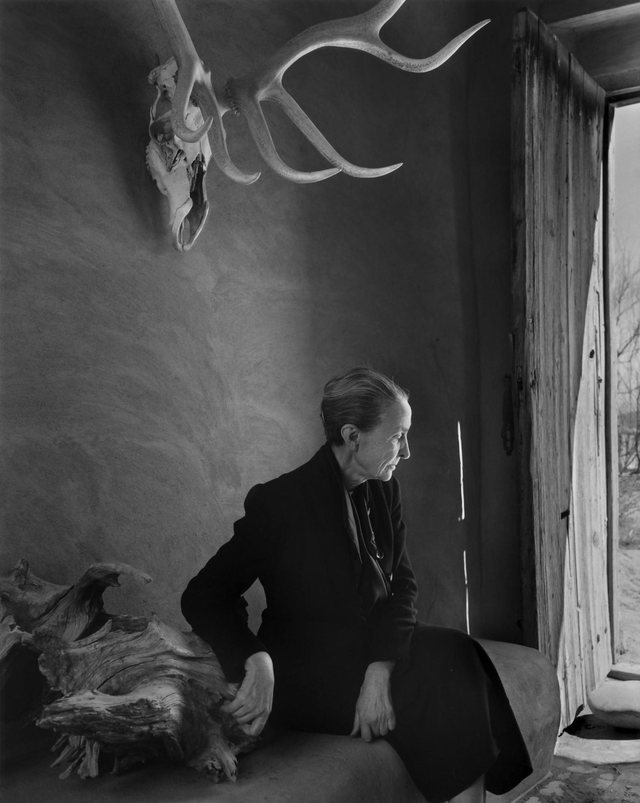
“I found I could say things in color and shape that I could not say in any other way.” – Georgia O'Keeffe, Some Drawing Memories
A canvas awash with the colors of a sunset, colors that radiate like flames. At first glance, this painting may seem like an impossible, abstract image. But a closer look reveals the soft stems, lush petals, and velvety texture of the Canna lily. This metamorphosis of natural subjects into abstract geometry is common in the work of Georgio O'Keeffe - revolutionary American painter and sculptor. But the magic behind this transformation remains as elusive as the artist herself.
Born in Wisconsin in 1887, O'Keeffe spent her childhood picking wildflowers and arranging fruit for painting. At age 17, she moved to Chicago to study at the prestigious Art Institute. Her teachers trained her to faithfully reproduce reality in the tradition of the European masters. Although she enjoyed the solitude and precision of this work, O'Keeffe felt little personal connection to it.
After settling in New York, she was drawn to the clean lines, striking compositions, and vibrant colors of Japanese art. O'Keeffe soon found a teacher whose teachings inspired her to put those interests into practice. Unlike her previous teachers, Arthur Wesley Dow encouraged his students to focus more on more abstract representations of light, form, and color. These lessons were manifested in O'Keeffe's first series of abstract paintings. Done in charcoal, they feature a series of wavy lines, strong shadows, and billowing clouds. These drawings defy easy classification by suggesting, but almost never connecting, to any specific natural reference.
Earlier European painters in the Cubist tradition had used rigid geometry to abstract external subjects. But here, O'Keeffe used the forms and rhythms of nature to capture internal feelings. Experiments like these would soon become a cornerstone of an artistic movement called American Modernism. Although no single style defines Modernist painting, its proponents shared a desire to challenge the realist tradition that dominated art education.
Beginning in the late 1910s, Modernist painting often used geometric shapes and strong, bold colors to explore the American psyche. O'Keeffe jumped into these experiments, but she was reluctant to share her new work. However, when a friend sent her charcoal drawings to art dealer Alfred Stieglitz, he was overjoyed.
In 1916, he organized a major exhibition in New York. This marked the beginning of O'Keeffe's career as a famous artist and of a relationship that would lead to their marriage in 1924. Marriage did not diminish O'Keeffe's taste for solitude. She traveled extensively to study, and often retreated to paint for months at a time.
Whether she was exploring the rugged canyons of Texas, the quiet forests of South Carolina, or the sun-bleached plains of New Mexico, her creative process relied on ritualistic, close-knit continuity. She paid meticulous attention to small details, and spent hours mixing paints to create the right colors with precision. When she discovered the perfect hue, she recorded them on her collection of handmade color cards.
O'Keeffe also experimented with perspective to elevate objects that were otherwise overlooked at first glance. In the painting "Ram's Head with a Horn," she placed a weathered skull and a delicate flower above the hills below. This massive skull obscures, shadows the landscape, presenting both the skeleton and the mountains in a new, supernatural light. The audience was captivated by her unique perspective and secretive demeanor.
She was particularly praised for her paintings of large flowers, ranging from fiery poppies to ghostly calla lilies. Stieglitz and other critics of the time were fascinated by Freudian psychology, and quickly linked these paintings to female genitalia. But O'Keeffe did not accept these interpretations. She could not stand the male gaze that dominated the art world, and demanded that her work be respected for its emotional evocation of the natural world.
Eventually, O'Keeffe settled in New Mexico, near one of the artist's favorite vacation spots. In her 70s, her eyesight began to fail her, but she continued to explore the mysteries of the landscape in a new, tangible way. O'Keeffe continued to create until her death at the age of 98, and is remembered as the "Mother of American Modernism." Decades later, her works retain their wild energy, and O'Keeffe her personal mystique.
Source: https://www.youtube.com/watch?v=4KQeu_mTYTQ&list=PLJicmE8fK0Ej26EQOOyY5o0PYLZdnuaMK&index=20