Caspar David Friedrich (1774–1840) is the name that crystallizes the essence of late German Romanticism: the focus of art on inner experience, religious meditation, and nature as a metaphysical space. He moved the landscape from a decorative backdrop to the main stage of human drama. In place of altars with saints and heroes, he placed foggy shores, frozen seas, and winter-shorn forests—not as beautiful landscapes but as figures of thought. From Monk by the Sea and Wanderer above the Sea of ??Fog to The Sea of ??Ice and Abbey in the Oakwood, his paintings invite the viewer to enter the great silence where man confronts the infinite.
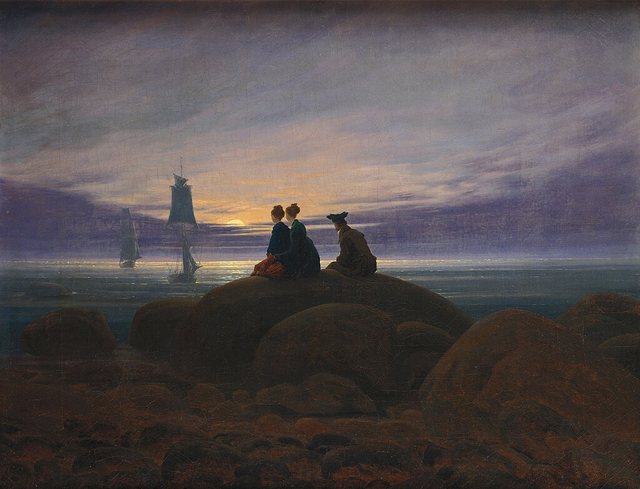
At the center of Friedrich’s language is the figure with a back (Rückenfigur), that solitary silhouette that looks out to the horizon and through which we, as viewers, “enter” the painting. This is a poetic and psychological innovation: the landscape is not simply an object for the eye, but a scene of a consciousness. In Wanderer… the character’s gaze, although invisible, becomes our bridge to contemplate the mist, the height, the danger, and the magic. In Monk by the Sea, the radicality of the void—boundless sky, open sea, a small sand—turns the painting into a pure experience of solitude and sublimation: the majesty of nature that surpasses us.
This romantic vision is not decorative escapism; it is visual theology. Friedrich, raised in the Protestant tradition of the north, sees nature as a “temple” where God is revealed: the faint lights of dawn, the full moon on the branches, the withered trees that rise like silent clergy. Crosses placed on cliff edges, ruined abbeys, distant Gothic churches—all are signs of a faith that seeks an inner life, not spectacle. In Cross in the Mountains (Tetschen Altar), the landscape itself becomes the altar: a bold statement about the times, which raises the stakes of the debate about the role of nature in modern spirituality.
Historically, late German Romanticism, like Friedrich’s, takes on political overtones, but not rhetoric. After the Napoleonic traumas and in the wake of German cultural resurgence, he selects symbols of the land—oaks, rocks, northern mists—as signs of stability and collective memory. Yet the painting does not shout; it whispers. His patriotism is internal, silent, a “love of country” that finds its mark in unwavering nature and the rhythms of the seasons.
Friedrich's aesthetic is restrained and disciplined: a cool palette, low or very high horizons, bold cuts, light absorbed by fog. These choices reduce the rhetoric of historical painting and increase the intensity of experience. He eliminates superfluous details, leaving only those signs that carry meaning: a dry tree, a moonlight, a sail lost on the horizon. This economy of means makes his work seem modern even today: images saturated with calm, but with philosophical tension.
His career saw acclaim and controversy, then a long oblivion and a 20th-century revival. Young critics and avant-garde painters—from expressionists to symbolists—saw in Friedrich a precursor to the psychology of the image. David d'Angers called him "the painter who discovered the tragedy of landscape"; that definition still holds true. When you contemplate The Sea of ??Ice, where ice breaks like knives on the hull of a ship, you see not just a polar disaster but an allegory of human limits in the face of nature—a theme that speaks directly to our era.
As the central figure of late German Romanticism, Friedrich teaches us that landscape is a state of the soul. He places man on the edge of the world—neither too high nor too low—to understand, with humility and courage, where our knowledge ends and mystery begins. This is why his paintings never age: they do not provide answers; they raise questions. And it is precisely in that silent space between us and the horizon that Friedrich’s Romanticism continues to breathe.