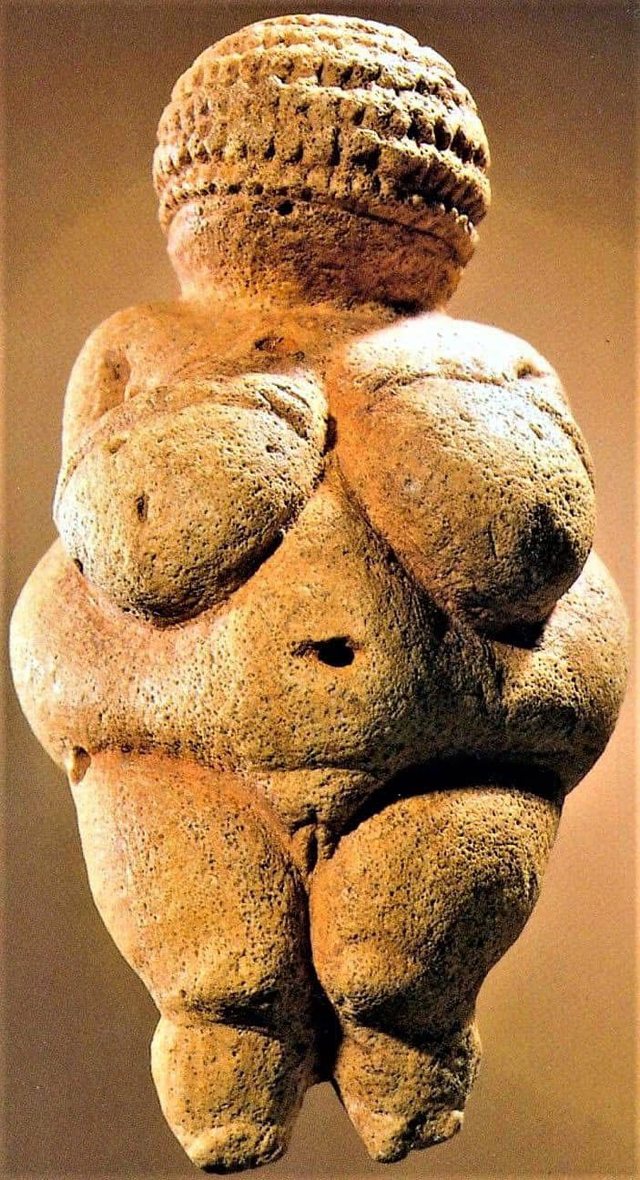
The first archaeological find of Western art is the so-called Venus of Willendorf, an extremely small (a little more than 11 cm high) Paleolithic statue found in Austria. In it we see embodied all the strange laws of the primitive cult of the earth. Woman is idol and object, goddess and prisoner. She is buried in the ample mass of her fertile body.
The Venus of Willendorf sounds comical because there is no criterion by which to consider it beautiful. But beauty had not yet become a criterion of art. In the Paleolithic, art was magic, the ritual recreation of what is desired. Cave paintings were not made to be seen. For us, their beauty is accidental. The walls of the caves were filled with bison and deer, along all the rocky exits and entrances. Art was magic, a call: Mother Nature, make the herds return so that the people have something to eat. The caves were the womb of the goddess, and art a sexual suffocation, a conception. It had rhythm and vitality, but not yet figurative status.
The Venus of Willendorf, a cult image half-carved from an unpolished stone, is not beautiful, because art has not yet found its connection with the eye. Her fat is a symbol of abundance in an age of famine. She is the excess of nature, which man is eager to use for his salvation.
The Venus of Willendorf carries her cave with her. She is blind and secretive. Her coarse braids, arranged as in a field of crops, seem to predate the invention of agriculture. Her forehead is furrowed. The absence of a face is the colorlessness of sex and primitive religion. There is still no psychology or identity, because there is no society, no cohesion. Men are torn and scattered under the explosion of the elements.
The Venus of Willendorf is eyeless because nature can be seen but cannot be known. She remains distant even as she kills and creates. The tiny statue, so overflowing and ritually made as it is, is ritually invisible. Before her, the eye shrinks. She is the cloud of archaic night.
Bloated, swollen, scorching, the Venus of Willendorf, bent over her belly, tends the cauldron of nature. She is eternally pregnant. She hatches, in every sense. She is the hen, the brooder, the egg. The Latin words ma-ter and materia, mother and matter, are etymologically related.
The Venus of Willendorf is Mother Nature as a primitive fertiliser, beginning to give birth to infantile forms. She is female, but not feminine. She is swollen with primitive forces, full of great hopes. She has no legs. If you stand her up straight, she might fall over. The woman is unable to move, crushed under the weight of her swollen breasts and hips. Like Aphrodite of Milo, the Venus of Willendorf has no arms. Instead, she has flat palms carved into stone, undeveloped, useless. She has no thumbs, and therefore no tools.
Unlike man, she can neither wander here nor there nor build. She is a mountain that can be climbed, but which can never move on its own.
Source: The book "Sexual Persons", author Camille Paglia