Language as a mirror of the collective soul
Every language is the way a people sees the world. It is not only a means of communication, but a mirror of sensitivity and philosophy of life.
In Japan, there are dozens of words to describe rain — from kosame (fine rain that falls like mist), to niwaka-ame (sudden rain that comes and goes within minutes), or samidare (continuous summer rain).
Meanwhile, the Japanese language has relatively few words for love in the literal sense. This is not a lack of feeling — but a sign of the cultural depth with which the Japanese experience the emotional world.
Sensitivity to nature
At the heart of Japanese culture lies the concept of “mono no aware,” which translates as “sweet sadness for the transience of things.”
So much language is devoted to rain because it represents precisely this sensitivity: something temporary, soft, that leaves traces and then disappears.
In every drop of rain, the Japanese see time flowing, life changing, memories dissolving.
Thus, rain is not just a meteorological phenomenon — it is a metaphor for life and human emotions.
Unspoken love
In Western culture, love is expressed in big words: "I love you," "I adore you," "I miss you."
In Japanese culture, it is expressed in silence, in gestures, in care. Love doesn't have to be loud to be felt — it lies in the details: in a cup of tea, in waiting for the rain together, in the slight bow of the head when greeting someone.
Thus, the lack of many words about love does not indicate coldness, but delicacy: the Japanese have turned feeling into the art of restraint.
Instead of words, they use feeling — love lived, not proclaimed.
Rain as a metaphor for emotions
In Japanese literature and poetry, rain appears as a reflection of inner states. It can symbolize longing, forgiveness, tranquility, or sadness.
In Bash?'s haiku, for example, a raindrop is like a human feeling: temporary, simple, and infinitely deep.
In this way, the Japanese language shifts emotion from man to nature, giving soul to the landscape and making it a fellow traveler of inner life.
Cultural sensitivity and beauty of content
In Western societies, feelings are often described with intensity and open declarations.
In Japanese culture, beauty lies in nuance and implication.
For them, excessive words impoverish the feeling — that's why words about rain are so numerous: they give shape to experiences that cannot be defined with an "I love you."
A people who have dozens of ways to describe the fall of water onto the ground have a rare sensitivity to the rhythm of life, the changing seasons, and the silence between emotions.
The fact that the Japanese have more words for rain than for love does not indicate a lack of feeling, but a different way of feeling.
For them, love is not to be said, but to be lived in simple and poetic ways.
Ultimately, perhaps this is the lesson that Japanese culture teaches the world:
words are limited, but feelings are infinite — like rain that falls slowly on the earth and, silently, nourishes everything it touches.
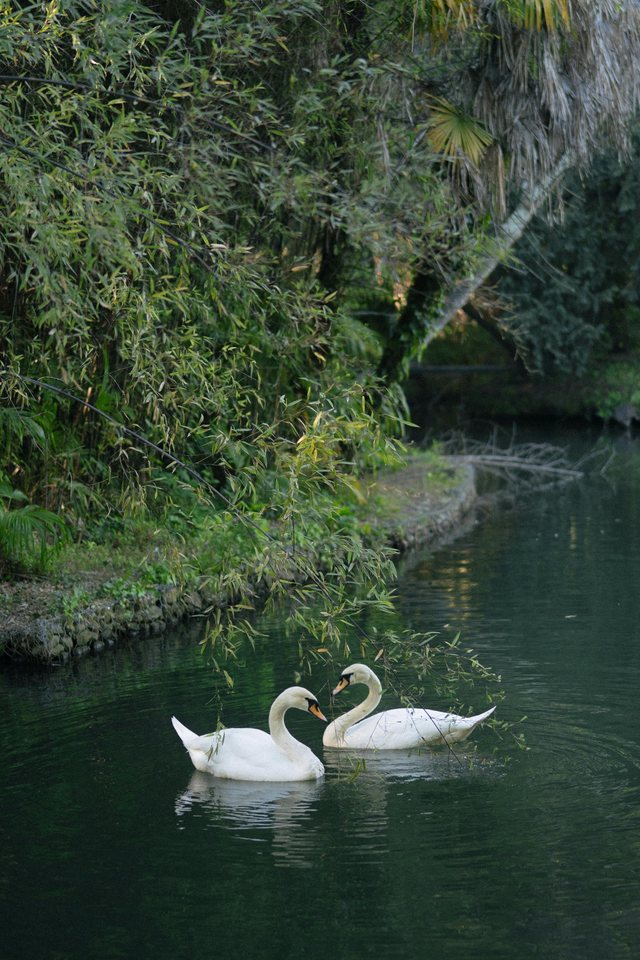
Photo by Yaroslav Shuraev: https://www.pexels.com/photo/white-swans-on-river-7958217/