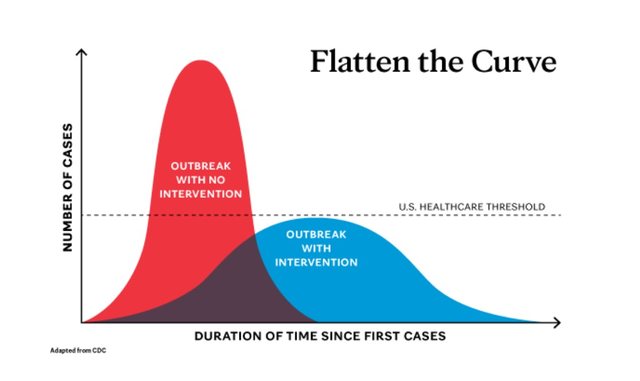
You have already heard the phrase "flatten the curve". It refers to trying to slow the transmission of Covid-19, so that the cumulative number of infections takes the form of a mild upturn, rather than a strong, almost vertical contagion.
The issue is urgent, according to infectious disease experts who have designed strategies to curb the spread. Inhibiting the virus, they say, requires immediate and drastic social distancing. To be effective, interventions must take months - not just days or weeks - and to avoid hospital overcrowding, it must more than halve virus transmission.
If instead the virus is allowed to multiply uncontrollably, a flood of patients is expected to overload health care systems, which are not equipped to cope with the number of people who will need treatment.
The US has already confirmed more than 100,000 cases, a figure that has doubled or tripled every three days for nearly a month.
With widespread transmissions, even a fraction of critically ill patients could overload hospitals. Experts at Imperial College London in collaboration with the World Health Organization project say that 4.4% of those infected with Covid-19 will require hospitalization. Of that number, 30% will need critical care, such as a respirator. And half of the critically ill patients will die.
In the absence of interventions, this means that 2.2 million Americans and 510,000 Britons may die, according to projections, while hospitals' intensive care capacities would be filled by the second week of April.
"The world is facing the worst public health crisis in several generations," Neil Ferguson, director of the Imperial College MRC Center, told Global Infectious Disease in a statement. (He developed symptoms last week and isolated himself.)
Imperial College researchers evaluated two strategies to flatten the curve: mitigation focused on slowing but not stopping the spread of the virus and suppression, which aims to reduce the average number of person-to-person transmissions to less than one. (Now it's about 2.2.)
Only oppression - the strongest intervention - would prevent US and British healthcare systems from overloading, they predict. "Suppressing" the virus, according to their model, would require social distancing across the population, combined with the isolation of people with symptoms at home and the closure of schools and universities. The interventions will have to start before the hospitals are overcrowded and stay in force for at least five months - possibly longer.
Abandoning the strategy before developing and administering a vaccine or other treatment, they warn, may cause the pandemic to recur.
Proof of such a possible outcome is the 1918 flu pandemic, when transmissions resurfaced after the measures were lifted.
Researchers acknowledge that there are many uncertainties, but they believe this strategy is the one most likely to ensure that, new infections will not exceed the capacity of intensive care hospitals, although they declined to estimate how many people can die if these precautions are taken.
"It's just very difficult to give a clear answer now," said Steven Riley, professor of infectious disease dynamics at Imperial College London, who worked on the analysis. "If we look at China, they have reached very low incidence levels, so we would expect very few deaths in the near future."
The less aggressive mitigation strategy modeled on by researchers requires home isolation of people with Covid-19 symptoms, voluntary home quarantine of confirmed cases, and social distancing of people over 70 (the most at risk group). Isolation and quarantine policies would last for three months, while the requirements for social distancing of those over 70 will remain in force for a month longer.
If this were done, the researchers predicted that about 1.1 million Americans and 250,000 Britons would die, and the demand for hospital intensive care beds would exceed supply, at a ratio of 1 to 8.
"Perhaps our most significant conclusion is that mitigation is unlikely to be possible without adding to the emergency capacity of health care in the US and Britain several times," the researchers write in their analysis.
"The need for social distancing is very strong," said Marc Lipsitch, professor of epidemiology at the Harvard School of Public Health, who contributed to the study. "People who get infected today need about three weeks on average before they get sick enough to need intensive care if they are to get so bad."
We need to act now, he said, to protect ourselves after three weeks. / With cuts from WSJ - Bota.al